CO2 emission was lower in the ABF treatment (compared to manure + inorganic fertiliser) but higher than the control and inorganic fertiliser – indicating higher microbial activity relative to the control and inorganic fertiliser.
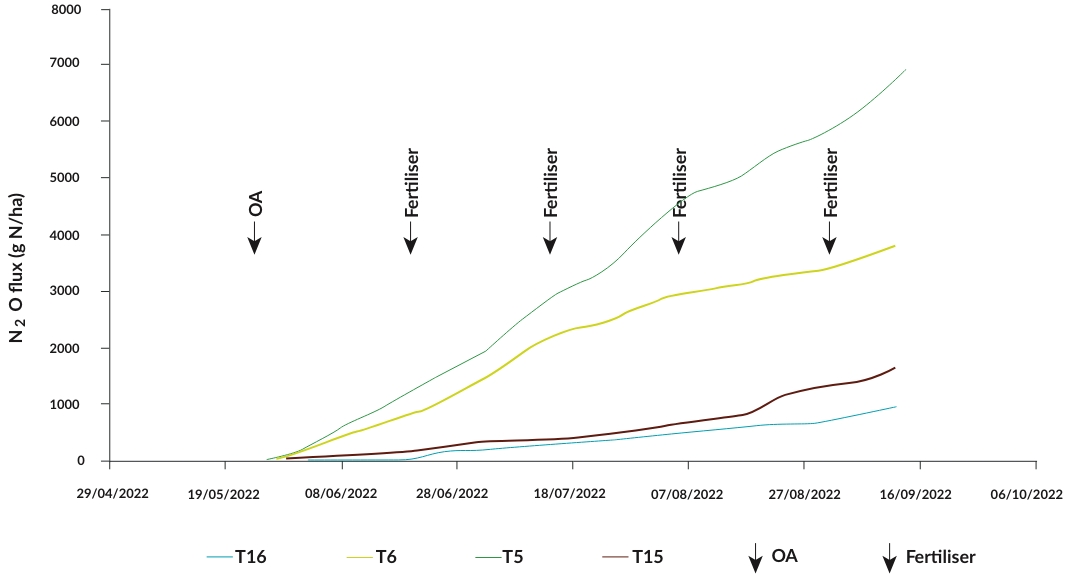
The ABF product used in this trial had lower N2O emission than the inorganic fertiliser and the manure + inorganic fertiliser. The total GHG (CO2-equivalent) emission from the ABF was lower than the manure + inorganic fertiliser (a common farming practice).
More data to be published
Trial details
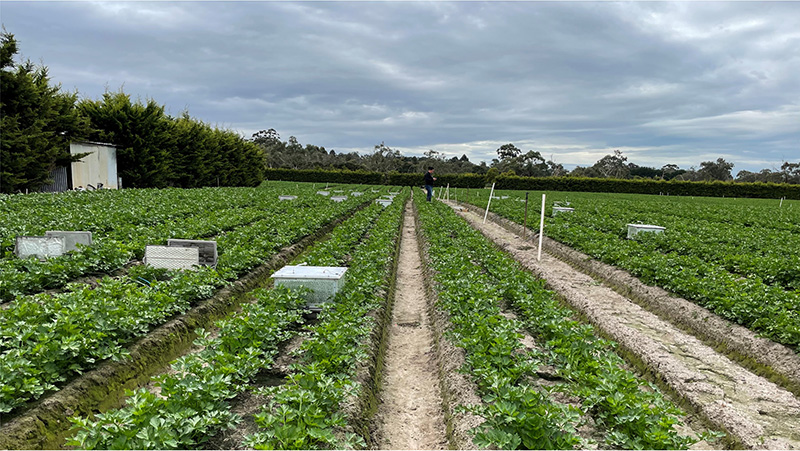
Field trial was established at a celery farm at Baxter, Victoria by Latrobe University. Treatments compared ABF products to standard farmer’s practice of using synthetic fertilisers and chicken manure. Treatment applications followed farmer’s practice of both pre- and post-plant fertilisaiton. Greenhouse gas emissions were measured from selected treatments using an automated chamber system.
Summary results/ discussion
Preliminary data from a field trial in celery show that the use of ABF fertilizers (D1, D5, B5 and B7) can reduce emissions of nitrous oxide from soil to the atmosphere by up to 86% compared with standard farmer practices. Higher N2O emissions observed in farmer’s practice of using manure + inorganic fertiliser and inhibitors. Lower emissions in ABF treatments could be due to slower release and/or transformation of nitrogen relative to farmer’s practice. This is important for plant uptake of nutrient and GHG emissions.
Photo: Celery field with automatic and static chambers for greenhouse gas measurements. Graph: Emissions of nitrous oxide over time from soils treated with different fertilizers, T5 = the farmer’s standard practice of pre-plant chicken manure + 6× applications of 20-00-16; T6 = the farmer’s standard practice using DMPP amended fertilizer; T15 = B5 at planting + 6× applications of D1; T16 = B5 at planting + 6× applications of D5.