Performance of the product(s) is better than soil only for both corn (clay) and lettuce (sandy), providing increased yield and higher nutrient uptake. This was more pronounced in sandy soil.
No phytotoxicity observed at both 500kg/ha and 1000kg/ha rates. In most cases, there was no significant and consistent added benefit observed at either 500kg/ha or 1000kg/ha rates.
Example: Corn plant dry matter observed in the ABF treatments was between 6.8 and 10.3 g/plant compared to the control (6.7 g/plant) and other treatments (manure, NPK, DAP, SOA) with dry matter between 7.8 and 12.4 g/plant when applied at 500 kg/ha. At 1000 kg/ha the dry matter recorded in the ABF was between 7.4 and 16.4 g/plant whist the rest of the treatments recorded values between 6.7 and 15 g/plant.
Higher microbial activity (based on CO2 emission) observed with addition of torrefied product, especially in sandy soil.
Trial details
This trial was conducted by IPF in a glasshouse at AgriBio, Latrobe University. The aim was to assess the effects of the ABF products on growth and yield of lettuce and how this compares with synthetic fertiliser and compost. There is an ongoing trial to determine the residual effects of the treatments in same pots/soils.
Summary results/ discussion
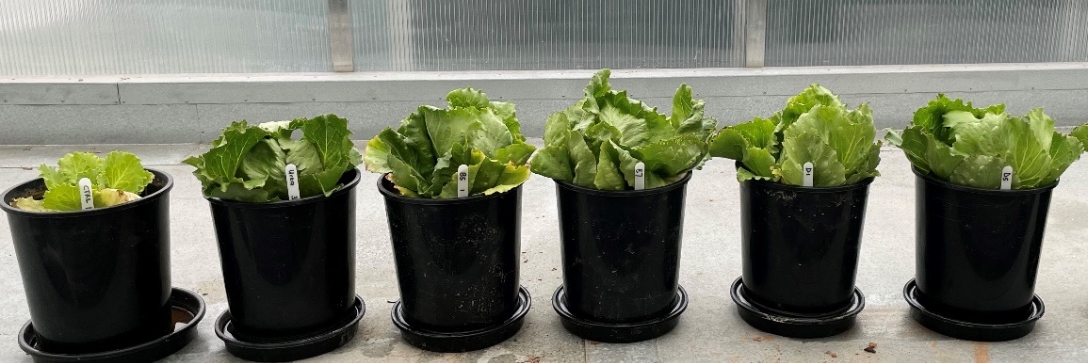
In addition to adding C to the soil, the ABF can perform similarly or improve crop yield compared to farmer’s practice. All ABF treatments had higher yield (average weight per lettuce) compared to compost and urea treatments. The SPAD values (estimate of chlorophyll content) at harvest was higher in all ABF treatments compared to soil only and chicken manure compost. Apart from the C1 which had a significantly lower SPAD value than the urea treatment, all the ABF treatments were not significantly different from the urea treatment.
Lettuce. Left to right: Soil only, Urea, B5, B7, D1 and D5
Graph: Average aboveground biomass (left) and leave chlorophyll content (right) of lettuce at harvest. B5, B7, C1, D1 and D5 are different formulation of ABF products.