Depending on the ABF formulation, cumulative CO2 emission (B1 = 233 to C1 = 462 kg/ha) was higher or lower than other commonly used organic amendment (biochar = 346 kg/ha and manure = 363 kg/ha). The emission of CO2 from the ABFs indicates that fractions of the total C is in labile form and able to support microbial activity.
N2O emission was lower in all ABF treatments (177-261 g/ha) compared to manure, biochar, and urea (301-494 g/ha). The lower emissions in ABFs could be due to slower release of nutrient. This is important in terms of nitrogen retention and uptake by plant and mitigating GHG emission.
Total GHG (CO2-equivalent) emission from the ABF treatments was lower than the commonly used organic amendments (manure and biochar). Emission from C1 was however like the organic amendments.
Most of the total GHG from C1 was contributed by CO2, a less potent GHG compared to N2O. Global warming potential (100-year timeframe): CO2 = 1, N2O = 265 and CH4 = 28 (IPCC).
Trial details
This trial was conducted by IPF at the Nutrient Advantage laboratory, Werribee, Victoria.
Summary results/ discussion
Nitrous oxide emission was lower in all ABF treatments compared to manure, biochar and urea. The lower emissions in ABFs could be due to slower release of nutrient. This is important in terms of nitrogen retention and uptake by plant and mitigating GHG emission.
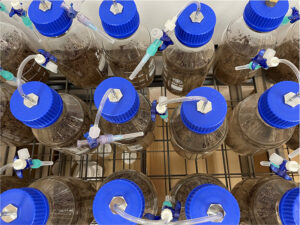
Photo: Incubation vials with fittings for greenhouse gas sampling for GC measurement. Graph: Cumulative nitrous oxide emission, over 22 days of incubation, from soil with different treatment applications.